trenchless sewer repair Sherman Oaks
<!DOCTYPE html>
The Real Cost of Traditional vs Trenchless Sewer Repair
The Real Cost of Traditional vs Trenchless Sewer Repair
Homeowners in Sherman Oaks face a specific sewer challenge. Many houses sit on mature landscaping and steep lots. Many laterals run beneath stone driveways and high-value hardscapes. Much of the pipe is older clay or cast iron. A leak or root intrusion can become an invasive and expensive project if handled with open trenching. Trenchless sewer repair offers a different path. It solves the same structural problems with less digging, shorter timelines, and fewer restoration costs. The true price is more than the bid on paper. It also includes site disruption, risk, time away from the home, and long-term maintenance. This article explains those trade-offs with local detail, using examples from Sherman Oaks, CA, and the greater San Fernando Valley.
What drives cost in Sherman Oaks
Soil, access, and pipe material shape the budget. Sherman Oaks Hills and Longridge Estates have slopes and mature trees. Roots are aggressive in the clay soil near Ventura Boulevard and Magnolia Woods. Older houses in 91403 and 91423 often have vitrified clay pipe at the property and cast iron under the slab. Joint connections in clay allow root intrusion. Cast iron corrodes and forms scale. Bellied sections hold water and solids. These conditions call for structural rehabilitation, not more snaking.
Restoration costs also drive the budget. A stone driveway or a stamped concrete courtyard near Chandler Estates can equal or exceed the sewer work. Traditional trenching cuts through sidewalks, masonry, and irrigation. Every cut needs full restoration. A trenchless approach places the money into the pipe itself. It protects the visible parts of the property. In higher value neighborhoods such as Royal Woods or Hidden Woods, this shift can be decisive.
Traditional dig-and-replace in context
Traditional sewer repair means open trench excavation. A crew locates the sewer lateral, exposes it, removes the broken section, and installs new pipe. The material is often PVC or ABS on private property. City right-of-way work can require ductile iron or specific standards. Excavation depth in Sherman Oaks varies. Many laterals lie at 3 to 6 feet. Hillside segments can run deeper. Deeper trenches need shoring. Street work can require traffic control and extra permits.
The direct costs include labor, equipment, pipe, fittings, and hauling. The indirect costs include breaking and replacing hardscape. Concrete replacement is common along driveways in Sherman Oaks Galleria adjacent streets and near Westfield Fashion Square. Turf and irrigation repairs follow. If the trench runs under a mature ficus or palm, a certified arborist may be needed. That adds time and money. The open trench also increases risk to utilities. Gas or electrical conduit can run nearby. Each conflict adds cost.
There are good reasons to open trench. If the line has severe offsets, major sags, or total collapse in several sections, full replacement may be the right call. If Orangeburg pipe is present and has flattened, bursting or lining may not be feasible. If the line needs upsizing for a new accessory dwelling unit near Studio City or Valley Village, full replacement can solve capacity limits. The point is simple. Trenching is not wrong. It just carries heavy restoration costs in established Sherman Oaks properties.
Trenchless sewer repair explained
Trenchless technology fixes the structural pipeline without long trenches. Two main methods apply for homes along Ventura Boulevard corridors and hillside streets. CIPP, also called cured-in-place pipe, and pipe bursting.
CIPP creates a pipe within a pipe. A felt or fiberglass liner, saturated with epoxy resin, is pulled or inverted through the damaged sewer lateral. A calibration tube inflates the liner so it bonds to the host pipe. Heat, steam, hot water, or UV cures the resin. The result is a seamless epoxy liner with a smooth finish. It seals cracks, bridges small gaps at joint connections, and blocks root paths. The new surface behaves like HDPE-quality flow. It resists corrosion. It reduces friction loss. Brands such as Perma-Liner and NuFlow supply liners and resins used by many Los Angeles County contractors. Tools from Ridgid, Picote, HammerHead Trenchless, and IMS Robotics help with inspection, cleaning, and reinstatement of branch lines.
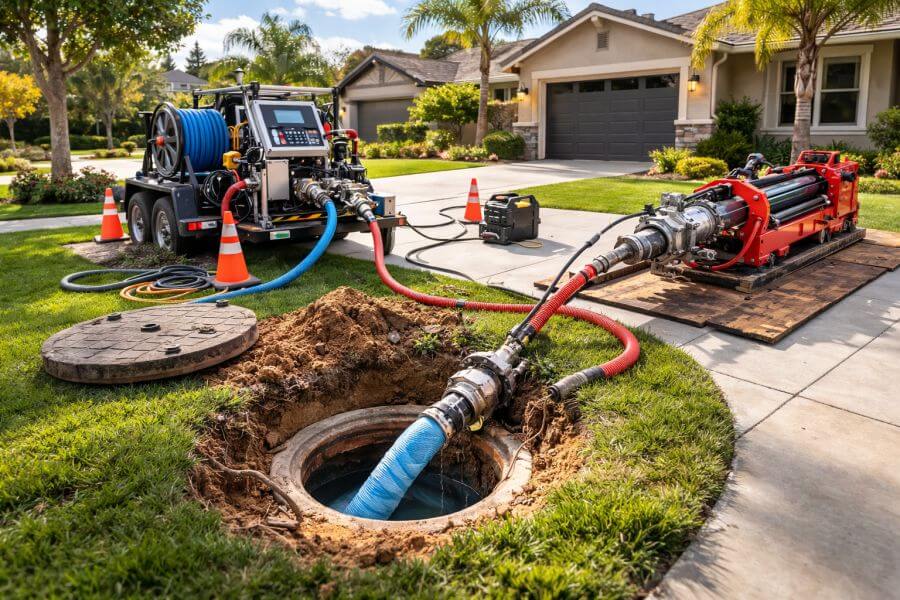
Pipe bursting replaces the old pipe with a new one using a cable and bursting head. The bursting head fractures the existing pipe while pulling in a new continuous HDPE pipe of the same or larger diameter. It needs small access pits rather than a long trench. It is a solid choice in areas where the pipe has collapsed or has major deformation. It also helps where upsizing is wanted. In Sherman Oaks soils, bursting performs well through old vitrified clay pipe and even cast iron, if flow paths remain.
Point repair can address a short defect such as a single crack or offset. A short CIPP patch installs over the problem area. This reduces cost where the rest of the line is sound. It is useful near cleanouts or between the house and the property line.
All trenchless methods start with proper diagnostics. A Ridgid HD sewer camera documents root intrusion, corrosion, bellies, and tie-ins. A locater marks depth and alignment across the yard, driveway, or parkway. Hydro jetting or mechanical descaling with Picote cutters prepares the host pipe. Descaling is vital with cast iron because scale can resist liner inflation. The prep phase sets the success of the final product.
Symptoms that signal hidden costs
Slow drains and gurgling toilets across the home suggest main sewer line troubles. If gurgling toilets pair with sewage odors from floor drains, root intrusion in clay pipes is likely. Recurring backups at the kitchen drain and a foul smell near the cleanout point to a broken lateral. A lawn with lush patches or a small sinkhole can indicate a leaking joint or bellied section. In some Sherman Oaks houses, foundation leaks connect to failed cast iron under the slab. Replacing that section with trenching can force demolition inside the home. Trenchless lining through the toilet flange or an existing cleanout can avoid that mess. That is a major hidden cost savings.
Backups that occur after rainfall near the Sepulveda Basin or Van Nuys Sherman Oaks Park areas can come from saturated soils or infiltration. Infiltration raises flow in the lateral and drives soil movement around joints. CIPP stops infiltration by sealing joints and hairline cracks. This reduces wet-weather risks and stabilizes the trench fill over time.
Permits, codes, and compliance in Los Angeles County
Work in Sherman Oaks falls under the City of Los Angeles jurisdiction. A C-42 Sanitation System Contractor license is the correct classification for sewer lateral work. Many projects also require IAPMO compliant materials. Any tie-in at the city main near a manhole needs a permit and inspection. Street openings need traffic control. Some addresses near Beverly Crest or Bel Air edges fall under hillside ordinances for excavation. The right contractor will set a permit plan and coordinate with the inspector. The wrong plan adds delays and standby time. That adds cost.
For trenchless projects, inspectors look for liner specifications, resin curing logs, and test data. The crew should document cure times and temperatures. They should show reinstatement of branch lines where required. They should leave the cleanout accessible with a proper cap. Transparency protects the homeowner at resale and supports insurance claims for prior damage.
Direct cost comparison in Sherman Oaks conditions
Numbers shift by address and scope. Yet local patterns repeat. On average, open trench replacement on private property may fall in the range of mid four figures to low five figures for short runs. Once hardscape cuts and restoration enter the scope, totals often double. A thirty-foot trench through a concrete driveway can require demolition, haul-off, compaction, base, and a two-pour replacement. If stone pavers or a custom entry sit above the lateral, masonry and sealing add more.
Trenchless CIPP lining typically runs on a per-foot basis with a setup cost. In Sherman Oaks, single-lateral CIPP projects with one access pit can land in a similar range as basic trench work. The difference appears after restoration. The yard stays intact. The driveway remains in service. There is little or no interior demolition. For many lots in 91403 and 91423, that is the real savings. It protects aesthetics and avoids weeks of dust and noise.
Pipe bursting carries similar per-foot pricing, with variations based on depth and obstructions. Bursting can replace crushed vitrified clay pipe and leave a new HDPE line in place. It does mean excavation for launch and reception pits. Yet those pits are compact and can sit in landscape strips near the sidewalk or in a planter bed. The restoration after bursting is smaller than a full trench, which reduces total spend.
Point repairs cost less but address only a segment. If multiple joint connections leak or if corrosion runs long under the slab, single patches turn into a piecemeal plan. The homeowner pays again for mobilization and setup. A full liner across the main sewer line can be more cost effective in those cases.
Time is money in occupied homes
A family in Sherman Oaks cannot be without service for long. With open trench work, services can be offline for one to two days or more for major sections. Dust and foot traffic pass through the site. If the work reaches the toilet flange under tile, the bathroom can be out of service for a week after tile restoration. A trenchless liner can cure in hours. Many liners are ready for flow the same day or the next morning. This shorter outage reduces temporary lodging, missed work, and stress.
Contractors also carry standby costs. An inspector delay on an open trench leaves machines idle. That downtime shows up in the final invoice. Trenchless projects often compress steps. Camera, cleaning, lining, and post-scan can happen in one sequence. That lowers the risk of delay and the soft costs that follow.
Longevity and maintenance profile
Old cast iron forms scale and rust. Clay has joints at regular intervals. Roots seek these joints. HDPE pipe from pipe bursting and epoxy resin liners from CIPP give a smooth, jointless path. That cuts maintenance calls. Hydro jetting frequency drops. Snaking becomes rare. A well-installed liner or HDPE replacement can offer a multi-decade lifespan. Many manufacturers note 50-year pipe lifespan targets under normal service conditions. The smooth bore also improves flow, which can help older kitchens and floor drains clear faster. That change can be measured with a post-lining flow test at the cleanout.
There are exceptions. Severe bellies still hold water even with a liner. Lining does not fix grade. If a section is ungraded or has settled soil, excavation or bursting may be needed to restore proper slope. A good inspection report shows these segments with depth marks and distances from the cleanout. Contractors should discuss this openly before any method is chosen.
Design details that matter on Sherman Oaks lots
Many homes near Longridge Estates have laterals under long driveways. The best plan is often a single CIPP liner from a cleanout near the house to the property line. If the city lateral connection near the manhole or wye is fragile, a felt end can be flared to improve the seal. If multiple branch lines tie in near the house, robotic cutters from IMS Robotics or Picote can reinstate those openings from inside the new liner. That avoids opening walls or floors.
Hillside properties near Deervale-Stone Canyon Park and Royal Woods present access issues. Large rigs cannot reach many backyards. Trenchless crews use compact inversion drums and portable boilers. They can stage near the curb on Ventura Boulevard or side streets without blocking driveways. This lowers traffic disruption and avoids citations. Traditional trenching in these areas often means days of manual digging and premium labor rates for shoring. The field reality shows up in the bill.
Homes near the Sepulveda Basin and flood-prone zones may see infiltration through joint connections. A liner seals those leaks and raises resilience. A camera after a heavy rain can confirm success. Water clarity and flow improve. Odors fade. Gurgling toilets stop. These are measurable gains with a cost impact because each future emergency call avoided is cash saved.
What contractors and tools say about quality
Accurate diagnostics come from high-definition cameras. Ridgid camera systems give crisp footage and reliable locates. That matters when mapping a sewer lateral that runs below a magnolia in Magnolia Woods or around a stone wall near Chandler Estates. Perma-Liner and NuFlow liners hold records and test data that local inspectors understand. That helps with IAPMO certified specifications. HammerHead Trenchless and Picote tools clear deposits and cut reinstatements cleanly. These brands do not win projects on name alone. They help the crew complete jobs right the first time. A clean lining start, an even cure, and a smooth finish reduce future callbacks. That lowers total cost of ownership for the homeowner.
Supply sources matter too. Basic fittings and ABS pipe are common at Home Depot and Lowes. Specialty resins and calibration tube sizes take ordering and planning. Crews who stock the right materials hit cure windows in the same day. Missed cure windows cause liners to fail. That is the kind of detail that never shows on the bid sheet yet affects real cost and risk.
Hidden costs homeowners forget to price
Restoration is the big one. A paver driveway near Sherman Oaks Galleria can consume a week of labor to restore lines and compaction. Stone sealing and pattern matching add cost. Irrigation and low-voltage lighting cross trenches and need repairs. Roots cut during trenching can destabilize a tree over years. Insurance may not cover that outcome. The safer path is to avoid the trench whenever the pipe condition allows it.
Noise and access during school or work hours cause soft costs. If the crew must block the driveway on a steep lot, family members lose parking. Deliveries get missed. If a project runs long due to unexpected utilities or rain, the home stays in work mode. Shorter projects protect daily life. Trenchless repair, done in a day, reduces stress for families with small children or older parents in care.
City inspections on open trenches can stack across days. If the inspector requests extra compaction or a modified backfill, the schedule moves. Each move ripples into tile crews or concrete finishers. It also increases the chance of change orders. With CIPP and pipe bursting, the city often inspects cleanouts, connections, and test results with less staging. Less staging equals fewer surprises.
Case snapshots from Sherman Oaks streets
On a block off Ventura Boulevard, a homeowner faced recurring backups. The camera showed root intrusion at every clay joint for sixty feet. The driveway was stamped concrete. Open trench estimates included a full driveway demo and pour. Trenchless lining through the existing cleanout took one day. The crew performed hydro jetting, descaled cast iron near the house, inverted an epoxy liner, and cured with steam. They reinstated the kitchen drain tie-in. The home kept its driveway. The cost came in well below the trench plan once concrete restoration was counted.
In Sherman Oaks Hills, a bellied section sat at twenty feet from the cleanout. The line also had corrosion under the slab. A full liner would not fix the belly. The crew used a point repair for the belly and a second short liner under the slab. Two access pits were cut in planters, not the patio. The belly was stabilized and sealed. The rest of the line flowed well. Total days on site were two, not seven.
Near Longridge Estates, a clay lateral collapsed at a joint near a mature jacaranda. Pipe bursting replaced forty feet with HDPE. The launch pit sat in a mulch strip. A reception pit sat at the property line. The tree stayed intact. The new pipe passed the post-camera test with strong flow and no sags. That outcome would have been difficult with open trench near the root zone.
How diagnostics build a reliable budget
A free sewer camera inspection is more than a sales step. It sets the scope. The crew runs a Ridgid HD camera from the cleanout. They mark the sewer lateral path and depth at key points. They record cracks, breaks, offsets, and corrosion. They spot the material type. Vitrified clay pipe behaves differently from cast iron or Orangeburg. Orangeburg deforms and can block a liner or bursting head. If suspected, a careful probe confirms its condition. The team then provides a map with footages, tie-ins, and a plan for cleaning.
Cleaning matters. Hydro jetting clears roots from clay and scours sludge. Mechanical descaling with Picote chains removes cast iron scale. This prep sets a surface for the epoxy resin liner to bond. The calibration tube size and resin volume are based on camera measurements. A well-documented plan cuts risk. That helps the homeowner compare bids from ServiStar and any competitor, including Roto-Rooter. Apples-to-apples means the same scope, not just a low headline price.
Safety, warranties, and lifespan reality
A C-42 licensed contractor takes safety and code compliance seriously. Shoring is set on trenches. Gas lines are located. Electric and fiber are traced. Cure logs are kept on liners. Pressure tests confirm seals on cleanouts. A clear photo record goes to the homeowner. Warranties vary by contractor and method. Many trenchless projects carry multi-year workmanship coverage. Manufacturers publish resin data and liner specs. When installed to spec, liners and HDPE replacements project decades of performance.
Homeowners also ask about chemical resistance. Epoxy liners resist household chemicals well under normal use. Grease from the kitchen drain will still cause issues if poured down the sink. That is a behavior fix, not a pipe fix. The good news is that the smooth bore of a liner helps grease travel out of the system rather than stick.
Sump pumps and ejector pumps in basements are rare in Sherman Oaks, but accessory structures can have them. Proper tie-in and venting matter for these appliances. A liner should not block any branch serving a toilet flange or floor drain. Robotic reinstatement opens these branches cleanly after cure, and the post-inspection confirms flow.
Where trenchless may not fit
Some lines are too deformed for a clean inversion. Severe bellies over long distances cut the liner’s chance to bond. Fully collapsed sections can block cable passage for pipe bursting. In these cases, a hybrid plan works. A short excavation fixes a collapsed segment. Then a liner handles the long run under the driveway. A good contractor in Sherman Oaks will suggest the hybrid if it saves the patio or protects a Royal Woods entryway without adding unnecessary cost.
Comparing total cost in a real-world formula
The total cost to the homeowner equals direct cost plus restoration cost plus time cost plus risk cost. Traditional trenching often lowers direct cost per foot but raises restoration and time costs. Trenchless often raises direct cost per foot but lowers restoration and time costs. In properties with high-end finishes, the crossover happens fast. In a basic yard with no concrete and a shallow lateral, trenching can still win. In the Sherman Oaks market, the median home has enough hardscape and mature plantings that trenchless methods make financial sense in most main sewer line repairs.
The final variable is longevity. If the liner or HDPE delivers a 50-year pipe lifespan and reduces maintenance calls, its lifecycle cost can beat a patchwork rebuild. That is the math behind many winning trenchless projects near Ventura Boulevard, Hidden Woods, and Magnolia Woods.
Simple homeowner checklist for faster decisions
Use this short list to move from guesswork to a plan that fits Sherman Oaks lots and codes.
- Confirm symptoms. Persistent slow drains, gurgling toilets, or sewage odors suggest main line damage.
- Get a free sewer camera inspection with recorded video and depth marks.
- Ask for one trenchless plan and one traditional plan with full restoration included.
- Check licensing. Look for a C-42 Sanitation System Contractor with IAPMO-certified materials.
- Price downtime. Ask how many hours service is offline and how access is maintained.
Targeted comparison for Sherman Oaks addresses
Zip codes 91403 and 91423 hold many mid-century houses with original laterals. These are classic candidates for trenchless sewer repair Sherman Oaks homeowners request most. A CIPP liner from a cleanout to the property line avoids driveway cuts. Pipe bursting replaces sections with heavy breaks. Point repairs fix small offsets near the house. Near 91411 and 91495 postal areas that share utilities with neighboring commercial corridors, access pits may sit close to sidewalks. Good crews coordinate with the City to avoid citations and manage traffic near Ventura Boulevard.
Encino, Studio City, and Van Nuys share soil and pipe patterns with Sherman Oaks. The same methods apply. In Valley Village, shallower lines and fewer pavers can tilt the math back toward trenching. In Bel Air and Beverly Crest edges, hillside rules and access limits often push toward trenchless again. The local context matters more than a generic price chart.
Service features that reduce risk and cost
Some contractors include a Free Sewer Camera Inspection for homeowners in Sherman Oaks. That alone can save hundreds before any work begins. 24/7 Emergency Service protects homeowners during off-hour backups and prevents water damage. Financing options help spread cost for major projects. No-Dig technology such as CIPP and pipe bursting protects driveways, patios, and mature landscaping. A clear warranty with a simple claim process builds trust.
ServiStar Plumbing and HVAC uses Ridgid HD cameras, hydro jetting, and mechanical descaling before repairs. For premium lining, Perma-Liner and NuFlow systems provide the right resin and liner for each pipe size. Crews follow IAPMO standards and City of Los Angeles code. Every project ends with a recorded post-camera and a written report. The goal is simple. A durable fix with minimal disruption that holds up for decades.
A brief method-by-method scorecard
Traditional trenching wins on fully collapsed lines with poor access for equipment and where restoration is minimal. It also wins when upsizing is required and bursting is not feasible. CIPP wins on long runs under hardscape, under slabs, and through root-prone clay with intact shape. Bursting wins where a new continuous HDPE pipe is desired and where joints have failed across lengths. Point repair wins for isolated defects with otherwise sound pipe. The main sewer line can be a mix. A hybrid plan can reduce overall spend while protecting the property.
Frequently asked local questions
Does CIPP reduce the pipe diameter too much? The liner wall is thin, and the smooth surface improves flow. The functional capacity is stable or better. Will the liner block the kitchen drain or floor drain? Robotic reinstatement opens each tie-in after cure. Are permits needed for trenchless? Yes. The City inspects cleanouts and connections. Do warranties cover root intrusion? Yes. The liner is seamless. It blocks roots at the old joints. If a new intrusion occurs at an unlined segment, that segment needs attention.
What about the cleanout? A proper cleanout near the house and at the property line helps future access. ServiStar installs code-compliant cleanouts with labeled caps. Can a liner pass under the sidewalk near Van Nuys Sherman Oaks Park? Yes. With proper access pits and curing controls, the sidewalk stays intact.
Why the cheapest bid often costs more
Low bids can skip proper cleaning, skip descaling, or undercount reinstatements. They may exclude concrete or paver restoration. They may avoid permits, which delays inspection release and final paving. They may use off-brand resin with poor cure data. When those corners get cut, the repair fails early. A second repair erases any savings. A complete scope, a C-42 license, IAPMO-certified products, and a documented cure give a higher success rate. In Sherman Oaks, where every square foot is valuable, a correct first repair saves the most money.
A practical, local decision path
Homeowners in Sherman Oaks benefit from a structured plan. Start with symptoms. Confirm them with a video. Get two methods priced with full restoration and downtime. Choose the plan that protects property value and delivers proven lifespan. For many addresses near Ventura Boulevard, Sherman Oaks Hills, and Longridge Estates, trenchless wins this test. It fixes the structure of the main sewer line with minimal impact to daily life.
Small comparison points that matter to inspectors and buyers
Inspectors want to see that the liner extends through the damaged area with good overlap. Buyers want to see a report with before and after footage. Appraisers respond well to documented upgrades with clear warranty terms. A new epoxy liner or HDPE lateral is a functional improvement with decades of benefit. It reduces the chance of a future Sewer Backup at closing. It reduces the chance of Foundation Leaks from undermined soil. These are real Sherman Oaks risks, and the market understands them.
Service coverage and response
ServiStar serves homeowners within Sherman Oaks zip codes 91403 and 91423 daily. Crews also respond to 91411 and 91495 locations as needed. Field teams stage near Ventura Boulevard for fast access. They reach Chandler Estates, Sherman Oaks Hills, Hidden Woods, Magnolia Woods, Longridge Estates, and Royal Woods. Nearby areas such as Encino, Studio City, Van Nuys, Valley Village, Bel Air, and Beverly Crest are within regular routes. The team understands the local soil, the older vitrified clay pipe, and the cast iron under many slabs. That local insight shortens timelines and cuts surprises.
Straight answers on materials
HDPE pipe used in pipe bursting is engineered for durability. Fusion joints create a continuous path. It resists root intrusion and chemical attack common in residential wastewater. Epoxy resin liners create a structural layer that bonds to the host pipe. Proper wet-out, inversion, and curing lock the material into place. Calibration tube sizing is essential. An undersized tube leaves wrinkles. A good crew documents these sizes and the cure profile. Manhole work needs coordination with the City. Joint connections at the city main must be sealed without intrusion into the public line. These material and interface details keep repairs clean and compliant.
A short, side-by-side decision helper
- Protecting a driveway or patio: CIPP or pipe bursting beats trenching.
- Severe collapse or long bellies: Hybrid plan or trenching where needed.
- Need to upsize: Pipe bursting often solves it with fewer pits.
- One bad joint only: Point repair is efficient and fast.
- Under-slab cast iron scale: Descale and line through the toilet flange or cleanout.
What this means for value in Sherman Oaks
Property value in Sherman Oaks hinges on curb appeal and functional systems. Driveways, courtyards, and mature landscaping frame that value. A trench that scars these finishes can undercut it. Trenchless sewer repair in Sherman Oaks preserves the exterior, upgrades the main sewer line, and cuts downtime. It removes root paths in clay, repairs cracked cast iron, and stabilizes bellied segments with targeted work. Over time, this reduces maintenance calls, emergency cleanups, and insurance claims. The net effect is a lower total cost and a stronger home profile for years.
Servistar Plumbing and HVAC
13351 Riverside Dr Suite #414
Sherman Oaks,
CA
91423
Phone: (818) 873-0613
Website: servistarplumbingandhvac.com